Here’s a few shots about the crankshaft renovation and a few words on the differences of the “regular” and Sport-crankshaft:
The crankshaft renovation was done by a fellow Saab-enthusiast Lasse Peltola. Many thanks to him for outstanding work.
I’m really sorry if the explanations are a bit hard to follow. I don’t know the correct terminology too well…
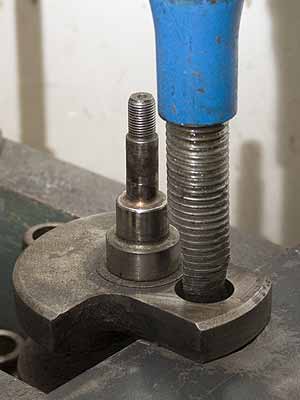
The crankshaft needs to be completely dismantled in a press to change the bearings. Actually you cannot see the connection rod bearings or the connection rod pin condition before you dismantle the shaft. The new bearings (and new pins if necessary) are also pushed to correct place in a press. After that the whole axle is put together again in a press.
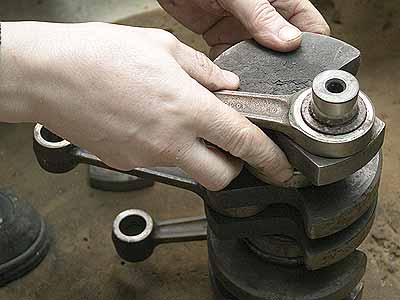
This connection rod pin is clearly worn and needs to be replaced:
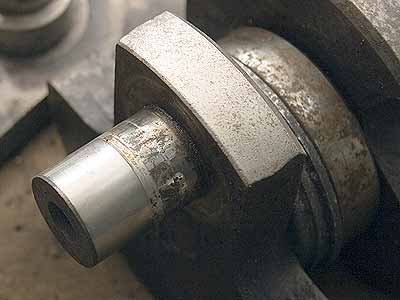
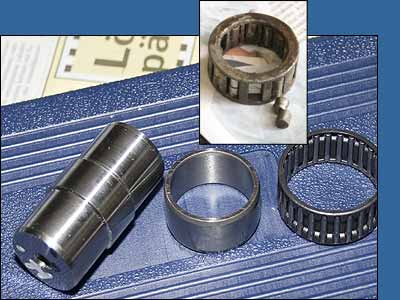
Above: The small picture shows the original roller bearing (with cast aluminium body) which were not very reliable on the long run. These are no-longer availlable, which requires that different type of bearing is used:
Main picture, from left, is the new connection rod pin (the center has bigger diameter to accommodate the new bearing). At center is the new bearings inner race and on the right the new needle-type roller bearing. This bearing has bigger diameter on the outside than the old one, so the connection rod big end needs some grinding.
The crankshaft main bearings are regular ball bearings and are readily availlable.
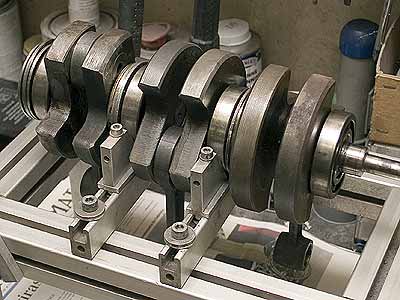
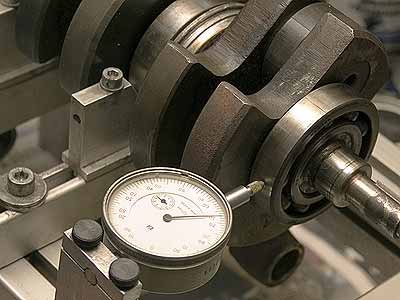
Pictures above: When the axle has been put together, it needs to be straightened (trued?). Straightening is a process of measuring the axle in a jig and hitting it with a hammer to eliminate the “wobble”. The factory tolerance for straightness measured as above, is less than 5/100 millimeter.
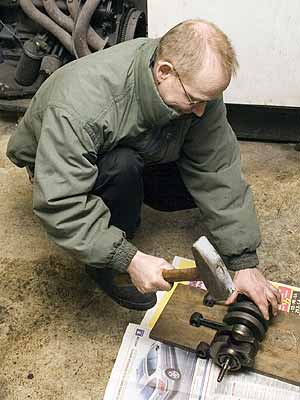
Here’s Lasse demonstrating the surgically precise hammer blows! 🙂 Don’t try this at home!
Really, this is best left to the experts.
And remember: Never drop the crankshaft! The odds are, it will not be straight afterwards…
A few pics of the Saab Sport crankshaft I recently managed to get hold of:
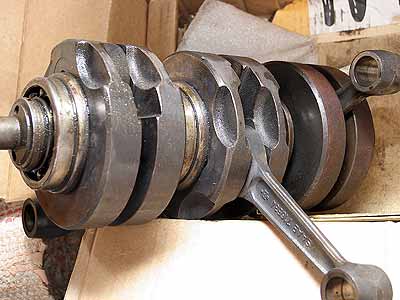
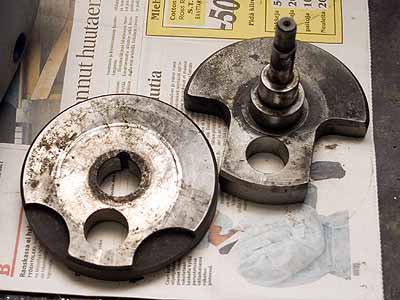
On the left the “counterweight” or limput (“loafs” as we call them) of the sport-type and on the right the regular one. The sport axle has more mass than the regular one and the fully round “loafs” ensure better balance of the whole crankshaft enabling higher revolutions.
The bigger “counterweights” also take up more space in the crankcase, which results in higher pressure in the cylinder (more mixture). This gives you more power.
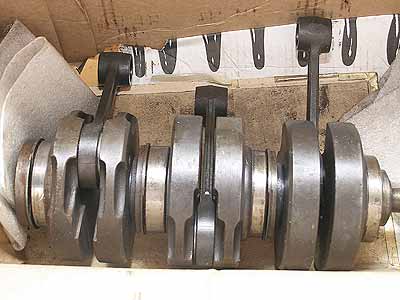
The Sport crankshaft also has better crankcase chamber-to-chamber sealing (see the sealing rings on both sides of the main bearings.
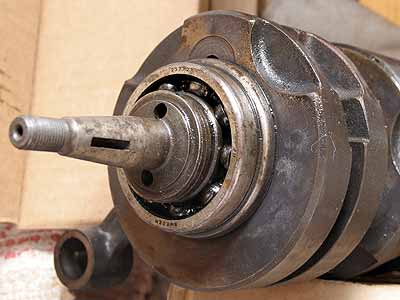
Above the full axle, very easy to identify by the fully round “loafs”.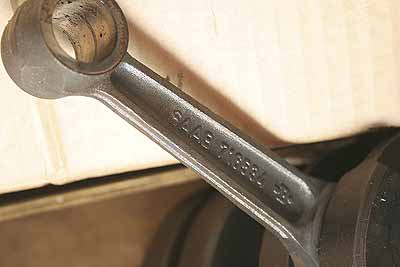
saw your part 20 on crankshaft renovation-can you tell me where I could get the crank pin/bearings? i have a regular crank I would like to rebuild but can’t find those parts. Thanks, NEC
Hi,
I don’t think you can find pins and bearings that directly replace the originals. The new conrod bearings were not the same size as the originals so the conrod big end needed to be honed bigger. And also the conrod pins on my car were purpose machined to fit the new bearings.
Here are the conrod bearing types and sizes (in millimeters) that we used:
Inner ring: SKF IR 30x35x17
Needle roller & cage: SKF K 35x40x17
On my car the pins for the main bearings were in good condition so they were re-used as such, only with new bearings (they are pretty standard skf ball bearings and easy to get).
I think some U.S. enthusiasts have had their crankshafts rebuild by Niklas Enander in Sweden. Check out http://www.classicsaabracing.com/motordelar-eng.htm and the “XP-Crankshaft Standard/GT” etc. section for more info. The prices are in Swedish kronor.
Hope this helps,
Tommi
Hi Tommi,
Did you have a chance to test your crankshaft in action? I mean high revs. at working temperature under the load? Especially I am interested in the big end conrod bearings. How are they holding? And one more question – are they somehow fixed axially or they are allowed to move along the pin and touch the weights?
Very well done and interesting site!
Hi. I have not yet had the chance to test this particular crank on high revs (the car is still a project, only a few slow test drives on the yard…).
Lasse makes the cranks for pretty much all historic class (Saab) rally cars here in Finland. As far as I know they work fine in racing, and this is exactly the setup they use for rebuild. Saab conrods are axially guided by the top end, so the fit in the big end is pretty loose sideways. I think it has something to do with lubricating the big end.
Thanks for the response. When I asked about axial positioning I meant the needle bearings. I believe it is not a problem that they can move and touch the weight, am I right?
I don’t know how tight the fit actually is but I believe the needle bearings can move along the pin slightly and touch the weight. It’s basically the weights that keep the bearings in right position.
Hey Tommmi
have you tried the new crankshaft yet?
Best regards,, Niklas Karlsson Sweden
Not yet, still trying to find time to work on the car.
But I do intend to take it to IntSaab2011, so I think I should start working on it pretty soon… 😀
Hi can you help i have a 1963 saab 96 two stroke and i am missing the drive gear for the distributor that goes on the front of the crank shaft and the front cover for the same thanks ray rees
Have you tried this crank yet?
It’s in use on the spare engine. So I have not driven with the engine in car but it works fine on the test bed.
Hi Tommi,why do you use the inner ring of the bearing? since you already had to make a special pin why not make the centre 35mm to suit the new bearing?
cheers
Dan
I’d need to ask the guy who made the repair to be sure, but I think it’s mainly a cost factor.
The ring and bearing can be purchased as a ready-made unit. If the ring would not be used the pin would need to be hardened (heat treated). I guess it’s more cost effective to use the ring than to have the pin heat treated.
If I see Lasse, I’ll ask him.
Br,
Tommi
Hello, I am writing u from Uruguay i have a 1965 saab 96 standard that was from my family and i am trying to repair it, so I want to ask u if u have some rebuilt crankshaft that can i use to repair mine cos here we dont have saab parts.
If u can help me or tell me if u know who can help me i will appreciate that
thanks
Carlos
Hi Carlos!
Unfortunately I do not have repaired crankshafts at the moment. You could check out ClassicSaabRacing. They can repair your crankshaft: http://classicsaabracing.com/Order/detail.php?item=169
Best regards,
Tommi